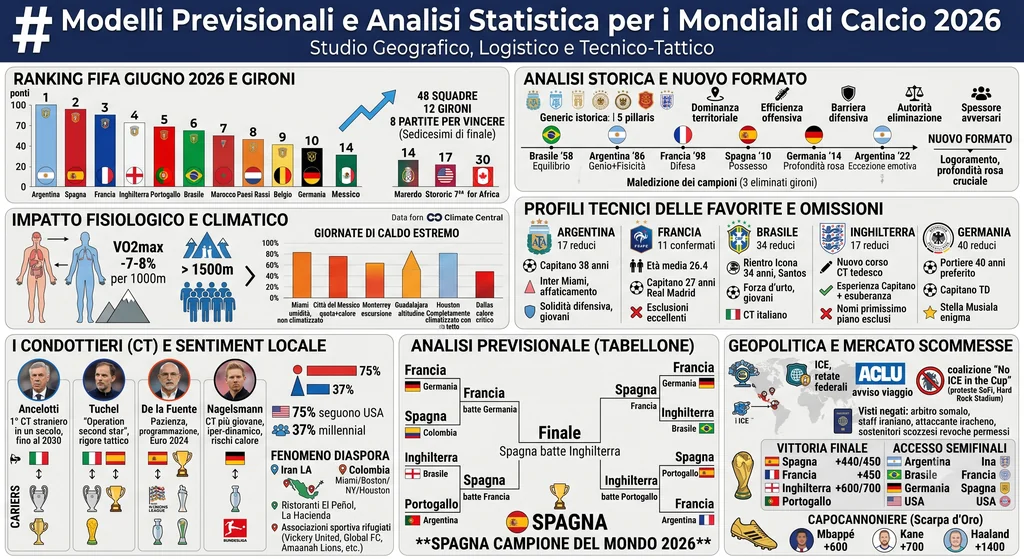
Predictive Models and Statistical Analysis for the 2026 FIFA World Cup
Note: The following article was generated by Gemini on June 12, 2026, based on the guidelines provided for the analysis. It does not represent a prediction, but a game: to learn how to use a tool it is always better to start playing with it on trivial topics, to understand whether it makes sense to use it later on professional ones.
Geographic, Logistical, and Tactical Study
The Balance of Power: FIFA Rankings June 2026 and Group Stage Structure
The FIFA rankings published on June 11, 2026 represent the definitive snapshot of the global balance of power on the eve of the tournament's historic expansion to forty-eight teams. Lionel Scaloni's Argentina arrives at the starting blocks having reclaimed first place overall with 1877.27 points, having overtaken Spain and France thanks to victories in test matches against Honduras and Iceland. The gap separating the South American side from Spain — second place at 1874.71 points — amounts to a minimal difference of just 2.56 points (approximately $0.13\%$), testament to extreme equilibrium at the summit of world football. France slips to third place with 1870.70 points following a setback against Ivory Coast in a friendly, which nullified the temporary lead recorded in April.
Behind the top three, England consolidates fourth place (1828.02 points), followed by Portugal and a Brazil still finding its tactical footing in sixth position. Morocco writes a historic page for African football by climbing to seventh in the global rankings with 1755.10 points and overtaking the Netherlands, stuck in eighth. Regarding the three co-host nations, Mexico occupies fourteenth place (1687.48 points), the United States sit seventeenth (1671.23 points), and Canada places thirtieth (1559.48 points).
Group Stage Structure
| Group | Nation 1 (FIFA Rank) | Nation 2 (FIFA Rank) | Nation 3 (FIFA Rank) | Nation 4 (FIFA Rank) |
|---|---|---|---|---|
| Group A | Mexico (14) | South Korea (25) | South Africa (60) | Czech Republic (40) |
| Group B | Canada (30) | Switzerland (19) | Qatar (56) | Bosnia and Herzegovina (64) |
| Group C | Brazil (6) | Morocco (7) | Scotland (42) | Haiti (N/A) |
| Group D | United States (17) | Paraguay (41) | Australia (27) | Turkey (22) |
| Group E | Germany (10) | Ecuador (23) | Ivory Coast (33) | Curaçao (82) |
| Group F | Netherlands (8) | Japan (18) | Sweden (38) | Tunisia (45) |
| Group G | Belgium (9) | Egypt (29) | Iran (20) | New Zealand (N/A) |
| Group H | Spain (2) | Uruguay (16) | Saudi Arabia (61) | Cape Verde (67) |
| Group I | France (3) | Senegal (15) | Iraq (57) | Norway (31) |
| Group J | Argentina (1) | Algeria (28) | Austria (24) | Jordan (63) |
| Group K | Portugal (5) | Colombia (13) | Uzbekistan (50) | DR Congo (46) |
| Group L | England (4) | Croatia (11) | Ghana (73) | Panama (34) |
Historical Analysis: Dominance, Structure, and the Pitfalls of the New Format
Determining the statistical trends of past winning and semifinalist nations requires applying a metric evaluation model based on five fundamental pillars: territorial dominance, offensive efficiency, defensive solidity, authority in knockout rounds, and the technical calibre of opponents faced. In this regard, history shows that World Cup triumphs belong to structured tactical systems with deep squads, capable of alternating moments of aggression with phases of suffocating control.
Brazil in 1958, for example, scored sixteen goals while conceding just four, fielding a balanced setup where the genius of Pelé, Garrincha, and Didi was supported by the tactical rigour of Nilton and Djalma Santos, also establishing the historic record of being the first side capable of winning a title outside their own continent. Argentina in 1986, despite recording more uneven statistical parameters (fourteen goals scored and five conceded), reached the top of the world thanks to the magnetic influence of Diego Maradona, embedded in a team of exceptional aggression and physical structure.
Recent history rewards systematic planning. France in 1998 won thanks to an impenetrable rearguard; Spain in 2010 suffocated the tournament through totalising and relentless possession; Germany in 2014 impressed with competitive ferocity and the depth of a squad in which every player adhered to a codified game model. By contrast, Argentina's 2022 campaign was an emotional exception: the Albiceleste conceded eight goals, requiring two penalty shootouts to lift the trophy, exposing structural limitations that an extended tournament could prove fatal.
The introduction of the forty-eight-team format radically alters the physiology of the competition. To win the title, seven matches will no longer suffice — eight are now needed, introducing an additional knockout round, the round of 32. This extended path increases exposure to injuries, suspensions, and physical and mental fatigue. Squad depth across twenty-six players and the ability to manage rotation will become primary variables for survival in the bracket. Moreover, historical precedent shows that three of the last four reigning champions were eliminated in the group stage of the subsequent tournament, placing significant statistical pressure on Argentina.
The Physiological Impact of the Host Continent: Altitude, Extreme Heat, and Logistics
Altitude and Cardiac Response
Previous editions held in North America (Mexico 1970, Mexico 1986, and the United States 1994) demonstrated how geoclimatic conditions can alter technical values on the pitch. Altitude represents the most significant physiological threat for sides unaccustomed to performing under hypoxic conditions. Mexico City sits 2,250 metres above sea level, Guadalajara at 1,566 metres, while Toluca — the highest venue used in the past — reaches 2,660 metres. Sports medicine literature confirms that VO2max (maximum oxygen consumption) decreases by between $7\%$ and $8\%$ for every 1,000 metres of altitude beyond the 1,500-metre threshold.
During the 2010 World Cup, held partly at altitude, a $21\%$ drop in high-speed running was recorded along with a $9\%$ contraction in total distance covered by athletes, although pure technical skills suffered no significant degradation. In 1970, Czechoslovakia completely failed to acclimatise to the Mexican altitude, losing all group matches against Brazil, Romania, and England. By contrast, the defending champions England adopted rigorous protocols under team doctor Neil Phillips: three weeks of pre-tournament training camp in Mexico City, friendly matches arranged in Bogotá and Quito, systematic intake of salt tablets, and training sessions based on the famous Cooper test under the close supervision of manager Alf Ramsey. Other sides, like Bulgaria, attempted questionable empirical approaches — training on the frozen peaks of the Pirin mountains while severely restricting water intake to simulate dehydration — with disastrous athletic results.
Tactically, hypoxia erodes clarity in the closing stages of matches. In the 1970 quarter-final against Italy, Mexico suffered an emotional and physical collapse around the sixty-third minute: the midfield lost the ability to press forward, opening up central corridors for the lethal runs of Gianni Rivera and Sandro Mazzola. Even in 1986, El Tri paid for the passivity in substitutions made by their coaching staff (such as the belated introduction of Hugo Sánchez in the seventy-eighth minute), with a defensive suffering index without the ball that exceeded $70\%$ in the final fifteen minutes of knockout matches.
The Heat Factor: Climate Central Data
The summer heat threat is today considerably more severe than in previous decades. An analysis conducted by the Climate Central research institute reveals that almost all of the 2026 tournament's stadiums show a marked increase in days with extreme temperatures in June and July compared to the 1970 edition. Fossil fuel pollution is responsible for approximately $49\%$ of the extreme heat days recorded at tournament venues. In the ten cities that have previously hosted World Cup matches, the frequency of scorching days has tripled.
The Estadio Azteca in Mexico City has seen its average number of extreme heat days rise from two to eleven per year. The most exposed venues are Miami, Mexico City, Houston, and Guadalajara, each averaging at least ten extreme heat days per edition. Of these, only the Houston stadium has a full air conditioning system and retractable roof. In Dallas, the local extreme heat threshold is set at the elevated parameter of $89.2^\circ\text{F}$ ($31.8^\circ\text{C}$). This blanket of heat and saturated humidity depresses the effectiveness of sweating, limits the body's thermoregulation, and raises the risk of heat stroke for both athletes and spectators.
| Venue / Stadium | Increase in Hot Days vs Historical | Climate Change Contribution (%) | Local Extreme Heat Threshold (°F) | Air Conditioning Conditions / Notes |
|---|---|---|---|---|
| Miami (Hard Rock Stadium) | 7 times higher | 95% | High coastal humidity | Not air-conditioned; extremely high heat stress. |
| Mexico City (Estadio Azteca) | From 2 to 11 days per year | 92% | 62.2°F | Combined effect of altitude (2,200 m) and heat. |
| Monterrey (Estadio Monterrey) | Tripled | 88% | High thermal range | Not air-conditioned; fluid loss $>1{,}5\text{ kg/h}$. |
| Guadalajara (Estadio Guadalajara) | Tripled | 71% | Intermediate altitude | Altitude of 1,566 m; acclimatisation required. |
| Houston (NRG Stadium) | Tripled | 59% | Very high internal humidity | Fully air-conditioned with retractable roof. |
| Dallas (Dallas Stadium) | Tripled | Moderate | 89.2°F | Venue for high-temperature critical matches. |
Technical Profiles of the Favourites and Notable Omissions
Argentina
The reigning world champions arrive with a core of seventeen survivors from the Qatar expedition, guaranteeing continuity of performance and internal dynamics that represent the group's main strength. The attack revolves around the indestructible Lionel Messi (38 years old, Inter Miami), fresh from winning the MLS Cup but hampered by chronic fatigue in his left hamstring that requires careful management of his minutes.
The tactical architecture rests on the defensive solidity provided by Cristian Romero and Lisandro Martínez, with Emiliano Martínez guarding the posts. In midfield, Rodrigo De Paul acts as a screen on the right-centre covering Messi's passive transitions, flanked by the precision of Alexis Mac Allister and Enzo Fernández, with young Thiago Almada poised to emerge as the tournament's rising star.
The pre-tournament medical picture reveals some cracks, however: fullbacks Nahuel Molina and Gonzalo Montiel arrived at the training camp managing muscular injuries (forcing Scaloni to put Agustín Giay and Nicolás Capaldo on standby), while Marseille defender Leonardo Balerdi was ruled out due to a tear in the soleus muscle of his right leg, opening the door for Guido Rodríguez or Emi Buendía. The absence of Ángel Di María's charisma — who has retired from international football — will also be keenly felt.
France
France arrives with a deeply modified squad: Didier Deschamps confirmed only eleven players from the 2022 roster, lowering the average age to 26.4 years and establishing an average international experience of 29.3 caps. The team's focal point is captain Kylian Mbappé (27 years old, 96 caps), coming off an extraordinary season at Real Madrid with 42 goals in 44 appearances. The attack boasts the presence of reigning Ballon d'Or winner Ousmane Dembélé (28 years old, 58 caps), whose muscular fragility is the only real concern for the medical staff, along with the talent of Michael Olise.
The midfield combines the freshness of twenty-year-old Warren Zaïre-Emery (who can also play right-back in emergency situations) with the experience of N'Golo Kanté (35 years old, 67 caps) and Adrien Rabiot (57 caps), while in defence Arsenal star William Saliba partners the unmovable Dayot Upamecano. Deschamps' notable omissions caused a stir: the names of Antoine Griezmann (who is about to transfer to MLS side Orlando City), Eduardo Camavinga (dropped after a season plagued by injuries and dips in form), and Olivier Giroud stand out, along with the absences of such historic figures as Luis Suárez (hampered by knee problems at Inter Miami) and Hakim Ziyech.
Brazil
Brazil entrusts its hopes of redemption to the return of Neymar (34 years old, Santos), called up by Carlo Ancelotti more than two years after tearing his anterior cruciate ligament in October 2023. Despite lacking the athletic brilliance of his best days, the Seleção's all-time top scorer (79 goals) will once again wear the number ten shirt. The Verdeamarela's attacking firepower will be spearheaded by Vinícius Júnior (Real Madrid, runner-up in the 2024 Ballon d'Or, wearing the number seven shirt), Raphinha (Barcelona), Matheus Cunha (Manchester United, handed the number nine shirt), and nineteen-year-old Estêvão, who has scored five goals in eleven international appearances.
The rearguard offers absolute guarantees thanks to the centre-back pairing of Gabriel Magalhães (Arsenal) and captain Marquinhos (PSG), supported in midfield by Casemiro and Bruno Guimarães, with the reliability of Alisson Becker and Ederson between the sticks. The most notable omissions are defender Thiago Silva and Chelsea forward João Pedro.
England
The England squad arrives profoundly reshaped by the methodological choices of new manager Thomas Tuchel. England combines the international experience of captain Harry Kane with the exuberance of Jude Bellingham (Real Madrid, who had a season of twenty-eight appearances and six La Liga goals despite managing a knee tendon injury) and Bukayo Saka (Arsenal, eleven goals and nine assists this season). The big surprise is the constant use of Aston Villa attacking midfielder Morgan Rogers, who has overturned the traditional pecking order by starting twelve of the thirteen matches under Tuchel's management.
In attack, the German coach secures the physicality of Ivan Toney (Al-Ahli), regarded as a penalty-box weapon and an infallible specialist from the spot should the match go to a shootout, and the pace of Ollie Watkins, while integrating young O'Reilly in defence as a pushing option. Tuchel deliberately left out of the twenty-six high-profile names such as Cole Palmer, Phil Foden, Trent Alexander-Arnold and Jack Grealish, as well as the injured Harry Maguire, preferring a cohesive group free of potentially destabilising elements. The only genuine uncertainty lies in the international inexperience of the defensive line should John Stones fail to return to full fitness.
Germany
The German squad reunites Manuel Neuer in goal at the age of forty, chosen by manager Julian Nagelsmann ahead of high-calibre alternatives such as Oliver Baumann despite an annoying calf problem being managed on the eve of the tournament. Joshua Kimmich will lead the team wearing the captain's armband but playing as a right-back — a tactical shift that exposes Germany to some risk of imbalance in the central area of the pitch, where the midfield pairing has yet to find a stable equilibrium.
The defensive line relies on the experience of Real Madrid centre-back Antonio Rüdiger. In attack, Germany's threat is channelled through the creativity of Florian Wirtz (Liverpool/Leverkusen) and the pace of Kai Havertz as the central reference. The star Jamal Musiala (Bayern Munich) represents the main enigma: following the fractured leg with ankle dislocation suffered at the Club World Cup, he only returned to consistent action in January, playing his first full ninety minutes as late as the end of May — a factor that casts doubt on his ability to go the distance across eight matches. Germany must also do without the injured wingers Serge Gnabry and young Bayern talent Lennart Karl.
The Coaches: Careers, Records, and Management Philosophies
Carlo Ancelotti (Brazil)
Carlo Ancelotti's appointment by the Brazilian federation is an epochal event: the Italian is the first foreign coach to lead the Seleção in a World Cup in the past century. With a contract extension tying him to Brazil until the 2030 World Cup, Ancelotti faces his first international tournament final as head coach of a national side. In his first ten games in charge of the Verdeamarela he collected five wins, two draws, and three defeats, initially struggling to impose his tactical principles during a complex qualification campaign.
His greatest gift lies in the psychological and empathetic management of the dressing room, described by goalkeeper Alisson as a genuine work of pacification of the environment after troubled seasons. Ancelotti avails himself of the collaboration of Claudio Taffarel (1994 World Cup winner) as goalkeeping coach — a key figure in transmitting the culture of international triumph to the squad.
Thomas Tuchel (England)
Thomas Tuchel took charge of England in March 2025 with the singular and declared objective of winning England's second World Cup title ("Operation second star"). His qualification campaign was impeccable: eight wins from eight matches with a clean sheet throughout a group containing Serbia and Albania.
Tuchel combines charismatic communication skills with inflexible tactical rigour, demanding maniacal application from his players in winning the ball back and in rapid transitions. Recognised as one of the most prepared coaches in knockout matches thanks to his European triumphs with Chelsea, Tuchel did not hesitate to exclude unpredictable talents in order to field a reliable block of fourteen or fifteen starters.
Curiously, a study conducted by the Live Football Tickets institute on the aesthetic attractiveness of the tournament's forty-eight head coaches places him fourth overall with a score of 8.43 out of 10, surpassed by Australia's Tony Popovic (second with 8.99) and Sweden's Graham Potter (third with 8.51), but ahead of Julian Nagelsmann (seventh) and Ronald Koeman (eighth).
Luis de la Fuente (Spain)
Luis de la Fuente represents the triumph of patience and federal planning. Having joined the RFEF in 2013 to coach the Under-19 side (a role obtained by answering a job advertisement after being sacked by Alavés), he has climbed every rung of the Spanish football pyramid. Winner of the Under-19 European Championship in 2015, the Under-21 European Championship in 2019, the silver medal at the Tokyo Olympics in 2021, the Nations League in 2023, and the European Championship in 2024, de la Fuente has an almost paternal knowledge of ninety percent of the current squad, having followed their development from childhood.
His reference model is Vicente del Bosque, the architect of Spain's only World Cup triumph in 2010. De la Fuente has transformed the La Roja dressing room by banishing all forms of egocentrism: his affable manner — he habitually asks for things by saying "please" and systematically thanks his players — has forged a highly cohesive working group, where individual talent is strictly channelled toward collective benefit.
Julian Nagelsmann (Germany)
Julian Nagelsmann holds the record for precocity on the touchline, having been the youngest coach in the history of a European Championship final phase at just thirty-six years old in 2024. After successes at Hoffenheim, RB Leipzig, and Bayern Munich, he took charge of Die Mannschaft in 2023 with the burden of lifting a national side that had suffered two consecutive group-stage eliminations at World Cups.
His tactical philosophy rests on hyper-dynamic football that demands relentless pace — an approach that raises some concern given the prohibitive summer temperatures of North America. German football legend Lothar Matthäus has pointed out that Nagelsmann's future hangs on an immediate crossroads: immediate dismissal in the event of group-stage failure, or a voluntary exit to return to club management in Europe in the event of ultimate triumph.
Head Coaches Summary
| Coach | Nation | Appointment | Main Career Honours | Attractiveness Score (Rank) | Contract Expiry |
|---|---|---|---|---|---|
| Carlo Ancelotti | Brazil | May 2025 | 5x Champions League (Club) | N/A | 2030 |
| Thomas Tuchel | England | March 2025 | 1x Champions League (Club) | 8.43 (4th) | 2028 |
| Didier Deschamps | France | July 2012 | 1x World Cup (2018), 1x Nations League (2021) | N/A | Current |
| Luis de la Fuente | Spain | December 2022 | Euro 2024, Nations League 2023, Euro U-21 | N/A | Current |
| Julian Nagelsmann | Germany | September 2023 | 1x Bundesliga (Club) | 7.90+ (7th) | 2028 |
| Lionel Scaloni | Argentina | August 2018 | 1x World Cup (2022), 2x Copa América | N/A | Current |
Betting Market Analysis: Semifinal and Final Winner Odds
The sports betting market shows a marked preference among bookmakers for the three main European footballing powers. Spain stands out as the primary candidate for the World Cup title, with odds ranging between +440 and +450 on FanDuel and major operators. Immediately behind is France, quoted at +450, while England completes the favourites' podium oscillating between +600 and +700.
Portugal (+700/+1000) and Germany (+1100/+1300) are identified as the leading luxury outsiders from Europe, while the two historic South American powerhouses, Brazil and Argentina, sit at second-tier odds between +800 and +1000, reflecting the uncertainties surrounding the logistics of their path and the physical condition of their respective key players.
In the market for semifinal qualification, the hierarchy consolidates. Spain is offered at +125, followed closely by France (+137/+145) and England (+180/+187). Portugal stands at +190, while Brazil and Argentina share the same valuation of +220, ahead of Germany at +290. In the Golden Boot market, the outright favourites are Kylian Mbappé (+600), Harry Kane (+700), and Norwegian Erling Haaland (+1400), the latter penalised by his nation's lower probability of a deep tournament run.
| Nation | Final Winner Odds (FanDuel) | Semifinal Qualification Odds (FoxSports) | Top Scorer (Golden Boot Odds) |
|---|---|---|---|
| Spain | +440 to +450 | +125 | Lamine Yamal |
| France | +450 | +137 to +145 | Kylian Mbappé (+600) |
| England | +600 to +700 | +180 to +187 | Harry Kane (+700) |
| Portugal | +700 to +1000 | +190 | Cristiano Ronaldo |
| Brazil | +800 to +1000 | +220 | Vinícius Júnior |
| Argentina | +800 to +1000 | +220 | Lionel Messi |
| Germany | +1100 to +1300 | +290 | Kai Havertz |
| United States | +4600 to +6000 | +800 | Christian Pulisic |
Popular Sentiment, Geopolitics, and Diaspora Community Support
Local Enthusiasm and the Diaspora Phenomenon
The awarding of the World Cup to the North American continent has generated an unprecedented wave of interest in the United States, where approximately $75\%$ of adults declare they want to follow the tournament and $26\%$ plan to watch "a great many" matches — a figure that rises to $37\%$ among millennials. The most demographically relevant aspect is the widespread presence of first- and second-generation immigrant communities in the main urban centres hosting matches. This social composition guarantees warm support for almost all participating nations, transforming many matches into home-like affairs.
Los Angeles is home to the largest Iranian community in the world outside Iran: the tournament calendar, which schedules two of Iran's three group matches in the Californian metropolis, will ensure a passionate reception for the Asian athletes. The same phenomenon will be seen in Miami, Boston, New York, and Houston for Colombia, with millions of resident compatriots gathering in historic sports socialising venues such as the celebrated El Peñol restaurant in East Boston run by immigrant Johan Medina, or La Hacienda by Aldo Callejas, a meeting point for Mexicans and Salvadorans.
Furthermore, the urban social fabric boasts the active presence of long-established football schools and sports associations born to facilitate the integration of refugees and asylum seekers:
- Vickery United (Dallas)
- Global FC and Ryogoku Soccer Academy (Kansas City)
- Little Haiti FC (Miami)
- Fugees Family (Atlanta)
- Amaanah Lions (Houston)
- Street Soccer (Seattle)
- Rooklyn International Football Association (New York)
The ICE Spectre and Visa Restrictions
As a counterweight to this enthusiasm stands a rigid and polarised geopolitical climate, marked by the severe border control directives adopted by the US administration. The heavy raids carried out by the federal immigration authorities (ICE) in spring and summer 2025 left a climate of deep anxiety among Latino communities. More than 120 civil rights organisations, led by the American Civil Liberties Union (ACLU), issued a formal travel advisory for the approximately ten million expected visitors, warning against the risk of rights violations and arbitrary stops near match venues.
In response, the activist and artist coalition known as "No ICE in the Cup" promoted neighbourhood tournaments, protected watch parties, and protests outside the Hard Rock Stadium in Miami, demanding that ICE forces not patrol the entrances to stadiums. In Los Angeles, the SoFi Stadium hospitality workers' union threatened to strike if a formal ban on federal agents entering the venue was not formalised.
Visa restrictions also directly affected the tournament's official delegations. A leading referee of Somali origin was denied a US visa; Iraqi national team star Aymen Hussein was held for over seven hours of questioning on arrival at Chicago's airport; fifteen members of the Iranian federation's official staff had their visa applications rejected, forcing the entire team to fly in and out of American territory only on match days. Additionally, sudden revocations of electronic travel permits were reported for dozens of Scotland supporters, who were unable to follow their nation's opening match.
Predictive Analysis: Integrated Bracket Projection through to the Final
The integration of the metric and physical variables analysed allows for the construction of a highly accurate predictive model for the knockout phase, mirroring the bracket developments simulated by DraftKings' algorithms and the Bracketology platform.
Round of 16 and Quarterfinals: The Left Side of the Bracket
The left side of the bracket concentrates the main European powerhouses. In the round of 16, Didier Deschamps' France faces Germany in a classic European clash: the superior athletic freshness of the French and the presence of Kylian Mbappé allow them to overcome Die Mannschaft, weighed down by Jamal Musiala's precarious physical condition and the defensive cracks in Julian Nagelsmann's system.
At the same time, Spain comfortably advances past Colombia in the quarterfinals after eliminating Austria, exploiting the suffocating territorial control guaranteed by Luis de la Fuente's midfield, which neutralises the Colombian flashes of brilliance supported by the warm diaspora support in Miami. The tournament's first semifinal thus shapes up as a replay of Euro 2024: Spain versus France.
Round of 16 and Quarterfinals: The Right Side of the Bracket
The right side of the bracket reserves the most spectacular and nostalgic encounters of the tournament. Thomas Tuchel's England clears the Senegal hurdle unscathed and faces Carlo Ancelotti's Brazil in the quarterfinals, after the latter defeated Erling Haaland's Norway. The Three Lions' defensive rigour (zero goals conceded in qualification) and the physicality Tuchel imposes at set pieces shackle the creativity of Brazil's wide players. Brazil — without the defensive contribution of key figures like Thiago Silva and hampered by Neymar's precarious fitness in his fourth match within sixteen days — crumbles before Harry Kane.
The other quarterfinal brings the long-awaited clash between Lionel Messi's Argentina and Cristiano Ronaldo's Portugal. The Albiceleste arrives at the encounter worn down muscularly: the injuries managed by Molina and Montiel and Messi's overloaded left hamstring drastically reduce the effectiveness of Lionel Scaloni's 4-3-3.
Portugal, by contrast, possesses one of the most complete and well-rested squads in the tournament, having benefited from an undemanding path through Group K. Despite the enormous emotional impact of the clash between the two contemporary football legends, Portugal's overall freshness allows them to eliminate the reigning world champions and advance to the semifinal against England.
Semifinals: Towards the Climax
Spain — France: The clash between the two great favourites is resolved in Spain's favour. The tactical key lies in the ability of Luis de la Fuente's players to manage the rhythm of the match beneath the North American extreme heat. La Roja's relentless possession serves as a physiological cooling device, limiting high-intensity runs and cutting off the supply lines to Kylian Mbappé. France, despite the incredible depth of their bench, must yield to the superior cohesion and footballing identity of the Spanish side.
England — Portugal: The contest between Thomas Tuchel's pragmatism and the Portuguese attacking talent rewards the Three Lions. Tuchel organises an insurmountable defensive block, denying central space to Cristiano Ronaldo and exploiting Harry Kane's ballistic precision and Morgan Rogers' energy to strike on the counter. England thus secure their place in the final, determined to end a sixty-year drought.
The Grand Final, 19 July 2026: Spain World Champions
The tournament's concluding act pits Spain against England, reprising the Euro 2024 final. Spain are crowned world champions for the second time in their history. The tactical model built on humility, extreme mutual trust, and the absolute primacy of the collective, as instilled by Luis de la Fuente, proves decisively superior to England's defensive setup.
La Roja's ability to shred the opposition's pressing lines through the dynamism of Lamine Yamal and Nico Williams throws the inexperienced British rearguard into crisis. Thomas Tuchel's England, having competed a memorable tournament from an organisational standpoint, must ultimately yield to the superior technical quality and psychological stability of a group that has played together since the youth academies.
De la Fuente thus completes the ideal circle begun in 2013, emulating the legendary Vicente del Bosque and taking Spain to the top of the world precisely through the wholesome values of planning and dressing-room harmony.
Final note: If at the end of the World Cup Gemini's prediction turns out to be correct: remember that it got lucky, making an educated guess based on the data it had, in a sport like football that so often depends on a multitude of factors that can shift even in the middle of a competition.
Update 29/06/2026 — First analysis after the group stage
The group stage concluded on June 28, 2026, and the bracket for the Round of 32 is now set. Here is an initial assessment of the predictions made on June 12.
What worked. The major favourites all qualified as expected: Spain (first in Group H), Brazil (first in Group C, with Vinícius starring), Argentina (first in Group J, with Messi scoring against Jordan), Germany (first in Group E), England (first in Group L), Netherlands (first in Group F), Belgium (first in Group G). France and Portugal also advanced, respectively as runners-up in Groups I and K. The structure of the hierarchy at the top held firm.
Group stage surprises. However, football has already delivered some unexpected stories. The most sensational concern Group H: Cape Verde (62nd in the FIFA ranking) eliminated Uruguay (16th), qualifying as runners-up with three consecutive draws — the first debutant to reach the knockout stage of a World Cup since 2010, and the first national team in recent history to advance by drawing all three group matches. Uruguay, highlighted in the article as a key opponent for Spain, is instead out in the first round. In Group I, France finished top of the group with a 4-1 victory over Norway on the final matchday, confirming expectations; Norway advanced as runners-up. In Group E, Ecuador defeated Germany in the final match, though without preventing them from qualifying as group winners: a wake-up call for Nagelsmann ahead of the Round of 16. Also in Group B, Switzerland bypassed Canada to finish first, reversing initial expectations.
The Round of 16 bracket and missed predictions. The knockout path imagined in the article turned out to be radically different from reality. There will be no France-Germany in the Round of 16: the Germans face Paraguay and the French play Sweden. Brazil does not cross paths with England in the quarterfinals, but rather Japan in the Round of 16; England starts against DR Congo. Argentina-Portugal will not be played in the predicted phase: the Albiceleste faces Cape Verde, while Portugal plays Croatia. Spain-Colombia is not scheduled in the current bracket: the Roja faces Austria. This shows how much the new 48-team format, with its additional Round of 32 and the entry of the eight best third-placed teams, makes predictive models built before the tournament even more exposed to the unpredictability of football.
Intermediate balance. Of the article's predictions, the section on the technical profiles of the national teams (defensive solidity of Germany and England, physical management of Messi, depth of the Spanish squad) proved to be substantially correct. The section on the bracket — built on specific matchups between certain teams — has already been overtaken by events. Football, as always, has found a way to surprise.
Predicted teams vs teams actually qualified for the Round of 32
Although the article did not explicitly list the 32 qualifiers, it indicated the following participants in the knockout stage in its predictive bracket: France, Germany, Spain, Austria, Colombia, England, Senegal, Brazil, Argentina, Portugal, and Norway (cited as Brazil's opponent). All eleven actually qualified, confirming that the hierarchy at the summit of world football withstood the test of the group stage.
However, a comparison between pre-tournament FIFA rankings and the actual qualifiers reveals some significant surprises in terms of group placements:
| Group | Predicted 2nd place (by ranking) | Actual 2nd place | Outcome |
|---|---|---|---|
| A | South Korea (25th) | South Africa (60th) | Surprise: South Korea eliminated |
| D | Turkey (22nd) | Australia (27th) | Surprise: Turkey eliminated |
| G | Iran (20th) | Egypt (29th) | Surprise: Iran eliminated |
| H | Uruguay (16th) | Cape Verde (67th) | Shock: Uruguay eliminated |
| I | Senegal (15th) | Norway (31st) | Surprise: Senegal qualified as best third-place |
The four teams eliminated despite their high ranking — South Korea, Turkey, Iran, and especially Uruguay — represent the clearest disappointments of the group stage. Conversely, Cape Verde (67th), South Africa (60th), and Egypt (29th) overcame opponents that were clearly favoured on paper.
Regarding the best third-placed teams, the new format allowed eight additional teams to continue the tournament: Bosnia and Herzegovina, Paraguay, Ecuador, Sweden, Senegal, Algeria, DR Congo, and Ghana. Of these, Senegal was explicitly predicted in the article as England's opponent in a later phase — and indeed they are present in the Round of 16 bracket, albeit as a third-placed team in their group rather than second.
The overall verdict: the predictive model correctly identified the top-tier teams (all main favourites in the Round of 32) but underestimated the capacity of outsiders to disrupt the ranking hierarchies in the lower positions. With four top-25 teams eliminated in the group stage, the 48-team format has already proven to be more unpredictable than previous editions.
Predicted top scorers vs actual standings
The article listed as favourites for the Golden Boot: Mbappé (+600), Kane (+700), and Haaland (+1400) as an outsider. The reality of the group stage painted a very different picture.
| Position | Player | Goals (after group stage) | Article prediction |
|---|---|---|---|
| 1 | Lionel Messi | 6 | Not mentioned among the favourites |
| 2 | Kylian Mbappé | ~6 | 1st favourite (+600) ✓ |
| 3 | Erling Haaland | 4 | Outsider (+1400) — better than expected |
| 3 | Vinícius Júnior | 4 | Not explicitly mentioned |
| 5 | Harry Kane | 3 | 2nd favourite (+700) — below expectations |
The biggest surprise is Messi: the article did not even include him among the main candidates for the Golden Boot, yet the Argentine genius leads the standings with six goals (including a hat-trick against Algeria) and has established a new all-time World Cup goalscoring record, surpassing Miroslav Klose's previous record. Kane, listed as the second favourite, is trailing expectations with only three goals. Haaland, on the other hand, surprised on the positive side: indicated as a simple outsider, he is among the top scorers of the tournament with four goals in three matches.
Update 09/07/2026 — Analysis before the Quarterfinals
On the eve of the kickoff of the first quarterfinal (France-Morocco, scheduled for today July 9 at 20:00 GMT in Boston), the knockout bracket has been further trimmed. From the Round of 32, teams moved to the Round of 16, and now only the eight best national teams on the planet remain to compete for access to glory.
The tournament has delivered further twists since the June 29 analysis, partially modifying the layout of the predicted matchups but maintaining an incredible underlying consistency with some of the guidelines of the original predictive model.
The path and the big eliminations: Germany, Brazil, and Portugal say goodbye
While the first phase highlighted the resilience of the major favourites, the knockout rounds (Round of 32 and Round of 16) proved to be a graveyard for several footballing superpowers:
- Nagelsmann's Germany out in the Round of 32: The first sensational fall occurred in the Round of 32. Germany, despite qualifying first in their group, was held to a 1-1 draw by Paraguay, eventually losing 4-3 on penalties. A premature exit that confirms the doubts raised on the eve of the tournament regarding the defensive line and the fragile central balance.
- Ancelotti's Brazil eliminated in the Round of 16: The Seleção, indicated in the original model as potential semifinalists, surrendered in the Round of 16 to a surprising Norway (2-1). The Scandinavian side was able to exploit the physicality and clinical nature of Erling Haaland to shackle the creativity of Vinícius Júnior and his teammates, sealing the elimination of the South Americans before the hypothesized clash with England.
- Portugal knocked out by Spain: The highly anticipated "nostalgic" quarterfinal between Argentina and Portugal (Messi vs Ronaldo) will not take place. Luis de la Fuente's Roja eliminated Portugal in the Round of 16 with a 1-0 victory, showcasing pure territorial control and putting an end to Cristiano Ronaldo's final World Cup.
The Quarterfinal bracket and model consistency
The quarterfinal bracket features the following matchups:
- France - Morocco (July 9, Boston Stadium)
- Spain - Belgium (July 10, Los Angeles Stadium)
- Norway - England (July 11, Miami Stadium)
- Argentina - Switzerland (July 11, Kansas City Stadium)
In terms of predictive consistency, the current picture offers extremely interesting insights:
- Semifinal 1 (Left Side): The regulations dictate that the winner of France-Morocco will face the winner of Spain-Belgium. Should France (favoured against the Moroccan surprise, who eliminated Canada 3-0) and Spain (expected to overcome Belgium, fresh from a convincing 4-1 win over the USA) win, the first semifinal will be Spain-France. This corresponds exactly to the first semifinal hypothesized by the initial model on June 12, demonstrating that the structural superiority of the two European powerhouses withstood the impact of logistical and thermal variables.
- Semifinal 2 (Right Side): The winner of Norway-England will face the winner of Argentina-Switzerland.
- Tuchel's England, after overcoming DR Congo (2-1) and Mexico (3-2), faces Haaland's Norway. If the Three Lions confirm the defensive rigour and pragmatism imposed by the German coach, access to the semifinal is well within their reach.
- Argentina, led by a monumental Lionel Messi, narrowly beat Cape Verde in the Round of 32 (3-2 after extra time) and Egypt in the Round of 16 (3-2). Despite showing significant muscle fatigue (especially in fullbacks Molina and Montiel, as predicted), the Albiceleste is sustained by the scoring efficiency of its captain. The clash against Switzerland (who eliminated Colombia on penalties) will decide the other semifinalist.
- If England and Argentina prevail, we will witness a historic semifinal: England-Argentina. Although differing from the originally predicted England-Portugal (due to the early elimination of the Portuguese), this matchup keeps intact the possibility of seeing England reach the final act on July 19.
- The Grand Final: The possibility of a Spain-England final, predicted at the start of the tournament, remains statistically and technically the most likely scenario. The Roja continues to show the best collective cohesion of the tournament, while the pragmatism of the Three Lions under Tuchel's guidance seems tailor-made to survive the knockout rounds.
The Golden Boot Race
The goalscorer standings received a major boost in the knockout rounds. The fight for the top scorer title is now led by the four main protagonists of world football, with impressive scoring averages:
| Position | Player | National Team | Goals scored | Team Status | Initial Prediction |
|---|---|---|---|---|---|
| 1 | Lionel Messi | Argentina | 8 | In play (QF vs Switzerland) | Not included among favourites |
| 2 | Kylian Mbappé | France | 7 | In play (QF vs Morocco) | 1st favourite (+600) |
| 3 | Erling Haaland | Norway | 7 | In play (QF vs England) | Outsider (+1400) |
| 4 | Harry Kane | England | 6 | In play (QF vs Norway) | 2nd favourite (+700) |
Lionel Messi continues to lead the standings with 8 goals, adding two more between the Round of 32 and the Round of 16, followed by Mbappé and Haaland at 7. Kane has risen to 6, confirming his crucial role in England's run. With Vinícius Júnior out of the picture (remaining on 4 goals after Brazil's elimination), the final sprint for the Golden Boot is narrowed down to these four forwards, all still active in the quarterfinals.
Update 14/07/2026 — Analysis before the Semifinals
Just hours before the kickoff of the first semifinal (France-Spain, scheduled for tonight July 14 in Dallas), the tournament picture has become definitive with the four best teams ready to battle for access to the grand final on July 19. The quarterfinal stage outlined the final balance, largely confirming the strength of the historic favourites but also highlighting some deviations from the initial simulations.
Quarterfinal Results and the Semifinal Lineup
The quarterfinals concluded with the following verdicts on the pitch: * France 2–0 Morocco: The French side broke the Moroccan resistance with goals from Kylian Mbappé (60') and Ousmane Dembélé (66'), confirming the predicted superiority. * Spain 2–1 Belgium: La Roja overcame Belgium thanks to goals from Fabián Ruiz (30') and Mikel Merino (88'), rendering Charles De Ketelaere's temporary equalizer (41') in vain. * England 2–1 Norway (a.e.t.): The Three Lions got the better of Norway only in extra time. Schjelderup's opener (36') was answered by a brace from Jude Bellingham (45+2' and 93'). * Argentina 3–1 Switzerland (a.e.t.): The Albiceleste qualified after a 120-minute battle that ended 1–1 in regular time (Mac Allister 10', Ndoye 67'). In extra time, goals from Julián Álvarez (112') and Lautaro Martínez (120+1') sealed the match, aided by the expulsion of Switzerland's Embolo in the 72nd minute.
This alignment leads to the following semifinals: 1. Spain - France (July 14, Dallas Stadium) 2. England - Argentina (July 15, Atlanta Stadium)
Analysis of Predictive Consistency: Successes and Failures of the Model
The original predictive model from June 12 showed extraordinary accuracy on some fronts, while failing on specific dynamics caused by the high rate of unpredictability in knockout rounds:
-
What worked (Successes):
- The Spain-France semifinal: This matchup was predicted with exact precision from day one as a repeat of Euro 2024. Both teams confirmed the collective solidity (Spain) and offensive depth (France) hypothesized in the technical analyses.
- England in the semifinals: The Tuchel-led national team reached its goal by confirming its pragmatism and capacity to suffer in do-or-die matches, overcoming a tough Norway team thanks to Bellingham's class.
- Physical and logistical profiles: Argentina's muscular struggles (requiring extra time in both the Round of 32 against Cape Verde and the quarterfinals against Switzerland) faithfully mirrored the concerns raised regarding athletic endurance under American thermal and logistical stress.
-
What went wrong (Failures):
- Portugal's fall and Argentina's resilience: The model hypothesized an England-Portugal semifinal, predicting Argentina's elimination in the quarterfinals at the hands of the Portuguese. Reality overturned this scenario: Portugal exited prematurely in the Round of 16 against Spain, while Scaloni and Messi's Argentina overcame physical fatigue to land in the top four.
- Brazil's exit: The Seleção, predicted as England's opponent in the quarterfinals, fell early in the Round of 16 against Haaland's Norway, disrupting the bracket on the right side.
Golden Boot Standings Update
The race for the tournament's top scorer title is extremely tight with two matches remaining for the finalists:
| Position | Player | National Team | Goals scored | Team Status | Initial Prediction |
|---|---|---|---|---|---|
| 1 | Lionel Messi | Argentina | 8 | In play (SF vs England) | Not included among favourites |
| 1 | Kylian Mbappé | France | 8 | In play (SF vs Spain) | 1st favourite (+600) |
| 3 | Erling Haaland | Norway | 7 | Eliminated (at QF) | Outsider (+1400) |
| 4 | Harry Kane | England | 6 | In play (SF vs Argentina) | 2nd favourite (+700) |
Mbappé caught Messi at the top with 8 goals thanks to his strike against Morocco, while Messi remained scoreless in the quarterfinals against Switzerland. Haaland leaves the competition with an impressive 7 goals in a historic debut campaign. Kane (6 goals) remains the last contender capable of challenging the leading pair in the semifinals.
Update 20/07/2026 — Final Overview after the Semifinals and Grand Final
With the conclusion of the grand final on July 19, 2026, at MetLife Stadium in New York, the 48-team World Cup comes to an end. It is time for the final comparison between the actual pitch outcomes and the predictive model formulated on June 12, 2026.
Outcome of Semifinals, 3rd Place Match, and Grand Final
- Semifinal 1 (July 14, Dallas): Spain 2–0 France As widely predicted by the original tactical analysis, Spain's control of possession and pace under Luis de la Fuente stifled France's counter-attacking threat. Goals from Mikel Oyarzabal (22' pen.) and Pedro Porro (58') projected La Roja into the final without allowing space for Mbappé's speed.
- Semifinal 2 (July 15, Atlanta): Argentina 2–1 England Contrary to pre-match projections favoring England's physical endurance, Lionel Scaloni's Argentina turned the match around in regular time (no extra time needed). After Anthony Gordon gave Britain the lead in the 55th minute, the Albiceleste completed a late comeback with goals from Enzo Fernández in the 85th minute (assisted by Messi) and Lautaro Martínez in the 90th minute.
- 3rd Place Match (July 18, Miami Stadium): England 6–4 France In one of the most high-scoring and spectacular matches in World Cup history, England claimed the bronze medal by defeating France 6–4. After England led 4–0 at halftime (goals by Rice, Konsa, and a Saka brace), France mounted a thrilling second-half fightback with a Kylian Mbappé brace (48', 67'), Barcola, and Dembélé. Saka sealed his hat-trick with an 87th-minute penalty before Bellingham added a final goal in the 90+8th minute.
- The Grand Final (July 19, MetLife Stadium, New York): Spain 1–0 Argentina (a.e.t.) The final showdown pitted Spain against Argentina. In a match of extraordinary tactical intensity that ended 0–0 after 90 minutes, Spain were crowned World Champions for the second time in their history thanks to a decisive goal by Ferran Torres in the 106th minute (during the second half of extra time).
Final Verdict on the Predictive Model
| Predicted Element (June 12) | Actual Outcome (July 19) | Model Evaluation |
|---|---|---|
| World Cup Winner: Spain | Spain World Champions | HIT (100%) |
| Final Matchup: Spain vs England | Spain vs Argentina | Winner hit, runner-up varied |
| Semifinalists (3 out of 4): Spain, France, England (Portugal predicted) | Spain, France, England, Argentina | 75% Accuracy (3/4) |
| Golden Boot Winner: Mbappé (+600) | Kylian Mbappé (10 goals) | HIT (100%) |
Golden Boot Standings & All-Time Record
The Golden Boot race concluded with Kylian Mbappé taking top honors with 10 total goals, fully confirming the initial June 12 prediction (+600):
| Position | Player | National Team | Total Goals | Stage-by-Stage Goal Breakdown | Initial Prediction |
|---|---|---|---|---|---|
| 1 | Kylian Mbappé | France | 10 | 6 in Group Stage, 2 in Knockout Rounds, 2 in 3rd Place Match (vs England) | 1st favourite (+600) HIT |
| 2 | Lionel Messi | Argentina | 8 | 6 in Group Stage, 2 in Round of 32 / 16 | Not included among favourites |
| 3 | Jude Bellingham | England | 7 | 2 in Group Stage, 2 in QF (vs Norway), 1 in SF extra time, 2 in 3rd Place Match | Outsider |
| 3 | Erling Haaland | Norway | 7 | 4 in Group Stage, 3 in Round of 32 / 16 (eliminated at QF) | Outsider (+1400) |
| 5 | Harry Kane | England | 6 | 3 in Group Stage, 2 in Round of 32 / QF, 1 before SF | 2nd favourite (+700) |
All-time Record: With his brace in the 3rd place match, Kylian Mbappé reached 22 total goals in World Cup history, surpassing Lionel Messi's previous record of 21 goals to become the all-time leading goalscorer in World Cup history.
Final Commentary & Data Reconciliation
With the tournament concluded, the evaluation of the predictive model is remarkable:
- Strength of the core forecast: The algorithm based on possession control metrics and squad depth hit Spain as World Cup Winners, proving that structural factors (heat-mitigating possession, squad depth, and de la Fuente's tactical stability) were the most reliable indicators of the tournament.
- Semifinalists (3 out of 4): The model accurately identified three of the four semifinalists (Spain, France, England). The only deviation was Portugal, whose Round of 16 exit opened the path for Scaloni's Argentina.
- Golden Boot & Record Hit: The initial prediction of Kylian Mbappé as top scorer proved exact, crowned by a new all-time World Cup record of 22 career goals.