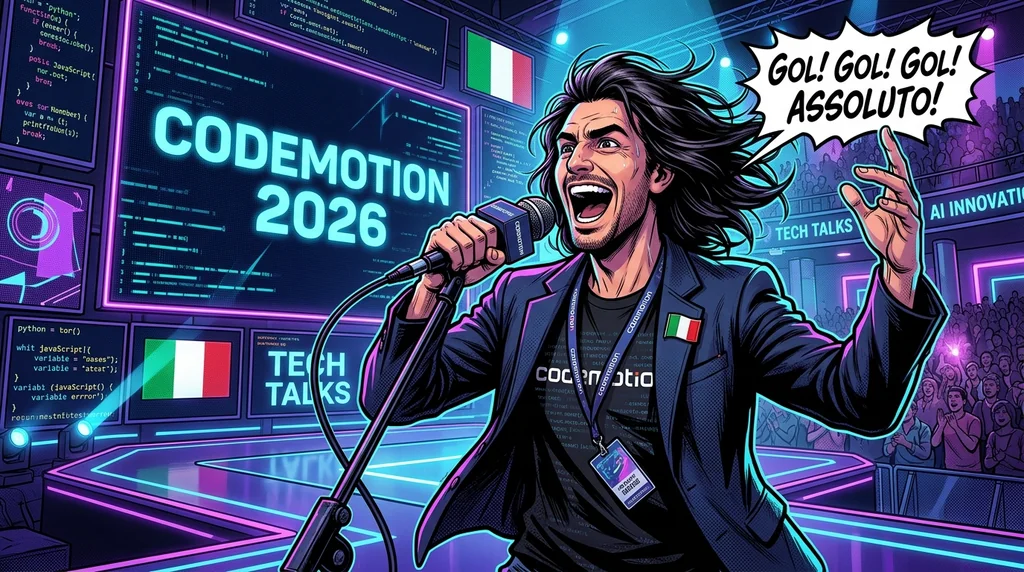
All standing for Codemotion: What if Lele Adani commented on the 2026 speakers
"Einstein said that coincidences are God's way of remaining anonymous. But you can't do that with Dios!" Lele Adani shouted it live on Rai TV during the England-Argentina semifinal of the 2026 World Cup, right when Enzo Fernández scored the equalizer assisted by Messi. At that moment, the commentary stopped being a mere broadcasting service and turned into a literary genre: standing in front of Messi, Adani wasn't just describing the plays anymore; he was celebrating them, prophesying them, committing them to history. "The dynamics of the unexpected is football," he yelled on another occasion during the same tournament, while half of Italy was divided between those who laughed and those who, deep down, were moved.
Now, I'm a fifty-something who has spent more time in front of a monitor than in front of a football match, and with the World Cup having just wrapped up (a nail-biting final won by Spain against Argentina), reading the lineup of speakers for Codemotion 2026 made me ask a dangerous question: what would a tech conference commentary sound like if done Adani-style? What would happen if we put the microphone in his hands, right in the front row, in front of the main stage?
There's only one way to find out. From here on, he's the one speaking—or rather, the skill I wrote to emulate his style. Everyone on your feet and applaud, because the microphone is in Lele Adani's hands, and the ball is the code.
The chosen one: Andrey Breslav
I've dubbed him "the chosen one," and many look at me with skepticism. But the point is that Breslav thinks about code in a more evolved way than anyone else. He took a language from scratch, named it Kotlin, and brought it to millions of users: he zeroes out the time between thought and play, between spec and implementation. And now, with CodeSpeak, he plays right on that thin line, the border between humans and code-writing machines. "Future of Programming: What's our place in the world of coding machines?": that is the question, gentlemen. He is a sort of attacking playmaker: he doesn't just score, he plays and scores. The top players in the game do that. Breslav has to stay right where he is, because he makes a massive contribution to the game and is way too important as a reference point for his teammates.
The best left foot in the world: Matteo Collina
Collina! Collina! Matteo Collina! The best maintainer in the world! Twelve billion downloads a year, one after another, unlocking the entire ecosystem. Open source! Everyone on your feet for this engineer who has too often been dismissed as replaceable, and yet he's the one keeping half of npm alive. Every "npm install" that succeeds in the world, somewhere, passes through one of his packages.
I can't believe it! I can't believe it! The twelve-billionth download! It had to be him, the routine of the extraordinary. Fastify! Pino! The heart of open source is infinite!
And look at the title of his talk: "Kill the Standup: How One Engineer Ships What Five Cannot". He runs like a defensive midfielder, works like an attacking midfielder, but delivers like a striker. A single engineer bringing home what five others cannot. The top forwards don't just score: they play and they score.
Everyone on your feet for Brazil: Erick Wendel
Everyone on your feet! Everyone on your feet for Brazil! Let's all dance with the Seleção of the runtime to honor the code. Erick Wendel, Node.js core team member, over a hundred talks in twenty countries, a hundred thousand people trained. And now he brings AI inside the browser, embedded, where nobody expected it. There is no room for the weak-spirited: those who love code must rejoice, delight, and, if they can, give thanks.
The garra: Alice Viola Setti
The garra! The final word goes to the engineers working close to the metal, always them! They have a different heart, do you understand that or not? Alice Viola Setti, from LLM agents to a native message queue on Postgres pushing a hundred thousand messages per second. Bare-metal datacenters built with bare hands, distributed systems, drones, computer vision. The claw that scratches, that leaves its mark on the architecture! Tired? Maybe. But leave her on the pitch, because she gets the final word in software. They're trying to teach infrastructure to someone who has screwed servers into the rack, I mean, check that out.
The dynamics of the unexpected: The critique of pure computer science
Santomaggio and Caressa take the stage with a title that speaks for itself: "Critica dell'informatica pura" (Critique of Pure Computer Science). Kant inside a keynote, do you understand that or not? Because the dynamics of the unexpected is computer science: what remains of the discipline of thought in an era when machines generate code faster than we can read it?
And playing on this same line is Fuggetta, full professor at the Politecnico di Milano, with "Why Coding Agents Need You More Than Ever". Because if the coding agent turns around and runs away, all you can do is turn it off. But you don't shut the agent down, you guide it: we still need someone who sees what others can't even imagine. Thirty years of software engineering give him exactly those eyes. The eyes of a world-class player, the eyes of a kid who loves software.
They choose their own position: The tactical brains
The top players choose their own position, the coach doesn't just assign it to them. Jigyasa Grover, who worked on machine learning at Twitter, Meta, and Uber, takes the stage to explain when NOT to use an agent: workflow, services, or LLM orchestration—reading the game before the technical move. This is tactical intelligence, gentlemen: a world-class player isn't the one who always shoots, but the one who knows when not to shoot.
And then Alfonso Graziano, who brought AI into the workflow of three hundred engineers at Nearform: he influences everyone—teammates, opponents, everyone. And Dennis Nerush, who rebuilt technical interviews from scratch in the era of AI: because now that even machines are touching the ball, figuring out who actually knows how to play has become the hardest job in the world.
At Mario speed: The ones who run
Stop, acceleration, they never catch him, they never see him! Rowdy Rabouw navigates the web "at Mario speed", green pipes and prefetching, twenty-five years of frontend in his legs. Graziano Casto, on the other hand, demands speed at startup: no more applications warming up for minutes, no more overprovisioning, the Pod must launch like a counterattack. And Gregorio Palamà makes LLMs run with MTP drafters, "Fast & Furious": there is no space, he generates it, he invents it. Speed without control is nothing, but control without speed doesn't win World Cups.
Water into wine: The Memedex
Mille e uno más! Marco Ippolito and Nicolò Giorgio index the internet one meme at a time, and that's turning water into wine from that position. Taking the most ephemeral thing on the web, the meme, and transforming it into an index, into knowledge, into a Pokédex of internet culture: it's unimaginable. Nobody sees that play coming, only they saw it. And one of them, Ippolito, spends his free time securing Node.js and sitting on TC39. Talent isn't explained, it is applauded.
You don't see that play coming: The small ones dribbling past the giants
But what kind of model did I just see? Stefano Fiorucci runs Doom on a 1-million-parameter ModernBERT in milliseconds. One million, gentlemen, not one billion: the little guy dribbling past the giants along the touchline, and nobody can catch him. And Egon Ferri goes beyond benchmarks, deep into ARC, asking what it really means to measure intelligence: because the number on the scoreboard doesn't tell the story of the match, and those who love this game know it.
History repeating itself: The archaeologists of code
One hundred and sixty-five years later, an emergency decree enters a pull request! Marco Liberati reads Italian law like a repository, commit after commit, from the Statuto Albertino onward: history repeating itself, the diff cutting across centuries. And Enzo Lombardi, ex-Microsoft and ex-Google, is "Racing the beam" against the electron beam of old cathode-ray tubes, while bringing the sounds of Italian arcade cabinets into MAME. This is honoring the history of the game: if you don't know where code comes from, you don't know where it's going.
The midfielder and the defense: The ones holding the line
Every winning team has a department that never ends up in the highlights. Alessandro Miliucci is the holding midfielder bringing order where everyone is stepping on each other's toes: distributed locks with MongoDB, keeping the ball covered when everyone wants it. Olena Kutsenko defends data in motion, because streaming without security is a high defensive line without a goalkeeper. Vladi Stevanovic deploys a zone defense on PR quality, in layers, like Swiss cheese: one hole gets through, four layers don't. And Abiodun Olowode asks the question that splits the locker room: we review the code, why don't we review ourselves? The group, gentlemen. First the team, then the ball.
The game expands: The pitch becomes the world
And the pitch expands, moving off the screen! Leonardo Cavagnis brings AI inside sensors with Arduino, from silicon to the physical world: the ball becomes matter. Soumaya Erradi makes a car's telemetry talk to an LLM, and the car, for the first time, answers you. Mauro Morales ships AI infrastructure as a versioned artifact, because a GPU node cannot be a snowflake: every match must be prepared like the final. Software no longer lives just in servers, it lives in the world. Open your eyes, the game is everywhere.
The heart: Ethics, the planet, and candy
And now, the hardest play, the one you can't train for: the heart. Giorgio Natili architects sovereign AI and digital dignity, because power without ethics is a hard shot way wide of the goal. Valeria Salis designs green prompting, because tokens weigh on the planet too, and Maurizio Mangione warns us that it's getting hotter and hotter in here: those who love this game must also take care of it. And Carolina Pinto, from Candy Crush, explains to AI how human behavior works: sharing love through a piece of candy, understanding the player before they even touch the screen. Fútbol belongs to the fans, software belongs to the users. Don't you ever forget it.
Respect for the number one: David McCarter
Everyone on your feet, one last time. David McCarter, Microsoft MVP, with more than twenty years of career, walks towards the sunset and takes the stage to teach others how to own a stage: "Unleash Your Inner Rockstar". The champion who, at the end of his career, doesn't hoard his talent, but gives it away. Respect for the number one. Index fingers pointed to the sky for someone who has played so much and now only wants to leave the game in a better state than he found it.
Nonna Celia: The communities
Index fingers pointed to the sky for the communities too, the greatest talent scout in the world, getting kids to practice when nobody else believes in them. Argoneto, AWS Hero from Basilicata, who founded user groups and the largest IT conference in southern Italy starting from a small mountain village: this is the Uruguay of code taking the pitch with everything they've got. Guglielmi with GDG Campobasso, Palamà with GDG Pescara, Aurélie Vache maintaining an open-source platform for speakers worldwide. None of them will end up in a World Cup broadcast, but without Grandoli there is no Messi. Respect for the Nonne Celia of computer science.
The Bobo TV of the web: Zotti and Bruno
And then there are them, Daniel Zotti and Stefano Bruno, who with "Shiftati di Testa" host "the most anticipated podcast on the web, even if the web doesn't know it yet." Their "Provocazioni Artificiali" is a talk so shifted that you'll want to steal the microphone from them. I recognize these two: the ones who understood that the game, in addition to being played, must be narrated. And that telling it well is a technical feat just like any other.
The last defender: Mario Zechner
And then here it is, the slide tackle: clean, right on the ball. Zechner, "Everything is slop, let's slow the f**k down". Someone who built coding agents with his own hands and is exactly the one who can say it: not everything that glitters is a golazo, and speed without thought only produces slop. Players aren't in a position to judge if something is good or not just because they're using it: that goes for supplements, and it goes for LLMs. This is also part of the match, gentlemen. The tackle is also epic.
Open your hearts
Now the microphone comes back to me, I'm grabbing it back from the keyboard of the agent that filled this page, stealing the style and perhaps a bit of the soul of Lele Adani, who I hope will read this tribute sooner or later and maybe have a good laugh.
Faced with this endless line of geniuses, going from Kotlin to memes, from Arduino sensors to 165 years of Italian laws read like a repository, one thing must be said Adani-style: the dynamics of the unexpected is computer science. Only here has a niche of nerds become the infrastructure of the world. Acceleration, stopping, there is no space, they generate it, they invent it.
Open your hearts, and be grateful that these people are still taking the stage for everyone, even for those who don't know how to love code.
And as a famous philosopher from Barengo once said
Code is the only thing that matters
or something very similar.