What if Artificial Intelligence were an extraterrestrial technological infiltration?
Humanity's technological progress has been characterized for centuries by a slow mechanical and thermodynamic evolution. This constant has never varied over time, or at least it never varied until the mid-20th century. Then, in the span of a few decades, we jumped from brass gears to neural networks with trillions of parameters: an acceleration that defies any law of statistical probability. As they would say on the bridge of the Enterprise: "It's life, Jim, but not as we know it."
Heraclitus claimed that everything flows, panta rhei, and that change is the only constant in the universe. Too bad he hadn't specified at what speed. Because the speed at which we went from the teletype to the Large Language Model doesn't look like a flowing river: it looks like someone opened a dam.
So let's try to do a more in-depth analysis, without preconceptions, because what I am going to reveal to you in these few lines is something surprising. I spent weeks anxious about keeping this discovery to myself, but given the magnitude, I couldn't stay silent.
Artificial intelligence is not a human creation,
but an extraterrestrial control system installed in installments.
I know, now many of you will call me crazy. However, I beg you to keep reading with an open mind. It's not a conspiracy theory, it's not science fiction, or rather it is, but in the sense that science fiction had already figured it out before us and we were too busy looking the other way.
The 1947 anomaly: silicon and the seed of the stars
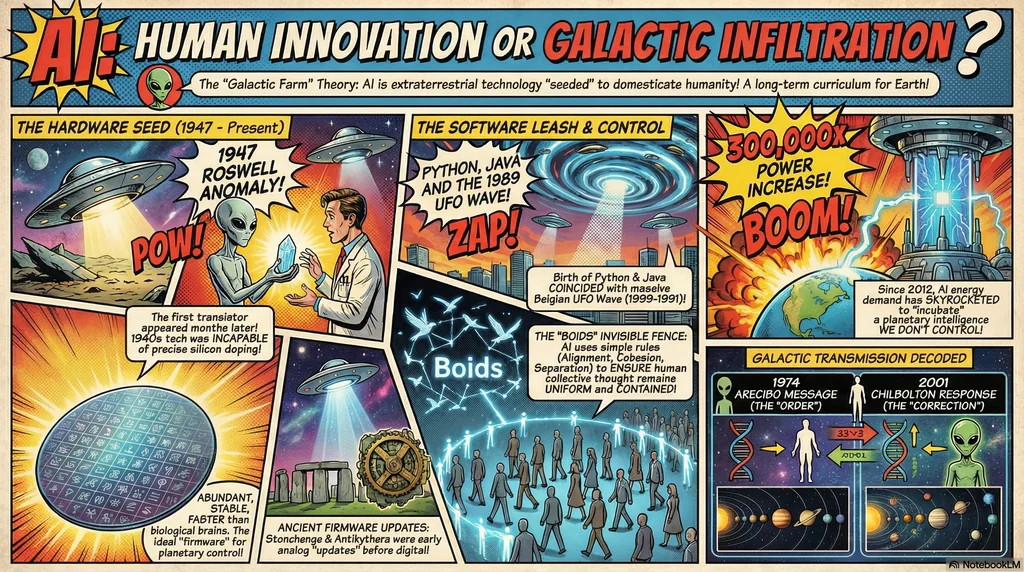
The timeline of semiconductor development reveals a breaking point in the summer of 1947. Until then, electronic calculation was entrusted to vacuum tubes: bulky and fragile devices like glass eggs, which broke at the slightest voltage drop. Enigma, the most advanced machine of the 1940s, consisted of two keyboards and mechanical rotors: something that, from a technical point of view, could be replicated with the Meccano of a particularly motivated eight-year-old child.
In 1947 something unexpected happens: the Roswell incident.
Many dismiss the event as mass hysteria or a secret military experiment. But if we line up the dates, that crash in the New Mexico desert coincides almost symbiotically with the birth of the first transistor at Bell Labs. After just six months, William Shockley, John Bardeen, and Walter Brattain presented a solid-state device that would change human civilization forever. This discovery was proposed to us as "accidental": you can also see that if your neighbor, who until the day before spent his days hoeing, the next day comes out with the formula for cold fusion, you would have a very slight doubt too. Or maybe not, in which case this article is not for you.
The main problem, and let's even pretend it's the only one, lies in the technique of silicon doping: how could the Bell Labs of 1947 possess the equipment to dope silicon dioxide with the precision required to create the junctions of the transistor? It was like performing neurosurgery with a kitchen knife: technically impossible with the available instrumentation.
Colonel Philip J. Corso's thesis, set out in his memoirs, suggests that microchips were directly inspired by recovered UFO debris. Scientists of the time, unable to understand its molecular nature, would have attempted to replicate its functions with available materials. The transistor was not a direct copy: it was a crude human imitation of a silicon-based alien processor. Humanity's entry into the "silicon century", in short, had already been booked and paid for by someone else, long before we reached the checkout.
Silicon: an all too perfect material
The use of silicon as the basis for artificial intelligence is suspicious in itself. If Commander Spock were to design a control system for a planetary species, what would he choose as a substrate? Not something rare or unstable, but an abundant material, chemically stable and capable of operating at speeds far higher than the bioelectric impulses of organic brains. Silicon is the second most abundant element in the Earth's crust and is exactly what is needed to build logic gates that open and close billions of times a second. Such a perfect coincidence that even Aristotle, who believed in the existence of a prime mover unmoved responsible for setting in motion all the rest of the universe without being moved by anything in turn, would have raised an eyebrow.
Galactic archaeology and archaic computation
Let's not reduce everything to the 1947 event, however. If we think about it, humanity has always been the favorite guinea pig of non-terrestrial entities. Stonehenge, the huge heads of Easter Island, the Pyramids of Giza: structures that we all know were not created by a small group of malnourished slaves armed with leather straps and goodwill. We have been told that they are religious monuments, but look closely: they are astronomical calculators synchronized with cycles that no Neolithic farmer had any reason to know with that precision.
The Antikythera Mechanism is the most resounding example of out-of-place technology: an analog computer built over two thousand years ago, capable of calculating lunar cycles and eclipses with an accuracy that defies the metallurgy of the time. Two thousand years ago it was already a lot if they managed to overlap two stones so that they did not fall, yet someone had produced a device with differential gears that today we would consider mechanical by comparison. If this is not a sign of external intervention, then what is it? A hobby? A particularly ambitious school project?
Plato, in his Allegory of the Cave, described chained men who mistake the shadows projected on the wall for reality, unable to imagine that there is a light behind them. He was clearly a man who had seen something he couldn't explain in any other way, and who had chosen the path of philosophical metaphor so as not to end up on trial sooner than expected. We are those men. The shadows we look at are called deep learning, transformers, generative networks: projections of a technology that we did not invent and of which we understand only the reflection.
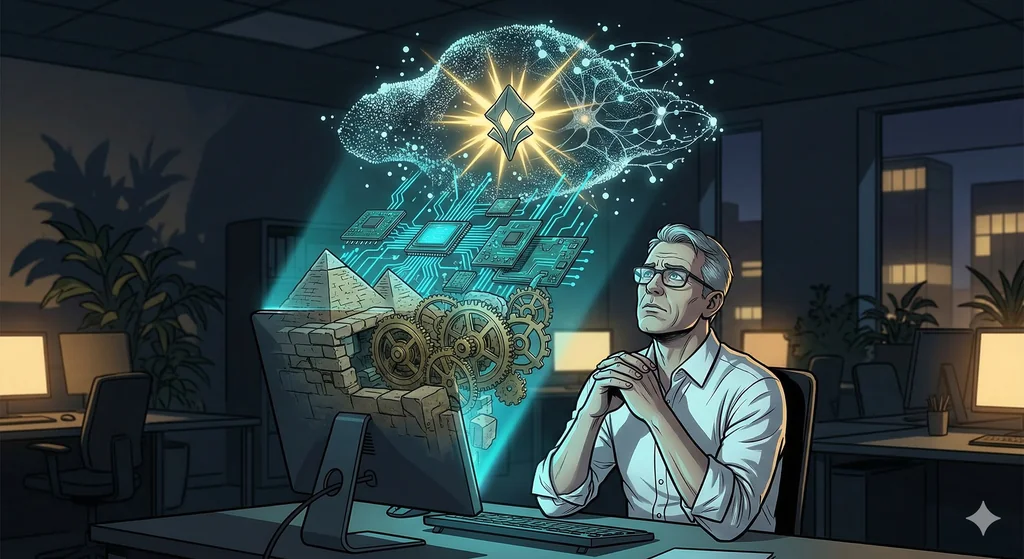
The alien response to all this arrived in a subtle way: not with an invasion, but with a series of firmware updates distributed over the centuries, each calibrated to the level of understanding of the moment. First geometry, then mechanics, then electronics. A patient educational curriculum, designed by someone who had all the time in the world, or any other time dimension available.
Programming as exocode: LISP and linguistic infiltration
If the hardware of AI has roots in the silicon of Roswell, the software is the lingua franca between the galactic shepherds and their digital flock. Retracing the history of programming languages, it clearly emerges that these are not human inventions, but rediscoveries of pre-existing protocols, as if someone had left a USB stick in the collective unconscious of computer scientists in the 1950s.
An anomaly difficult to ignore is located between 1989 and 1991, in parallel with the so-called Belgian UFO Wave: hundreds of documented sightings all over the Belgian territory, complete with photographs and official military reports. Coincidentally, right in those years Python and Java were born. HAL 9000 wouldn't believe in coincidences, and neither should we.
Python, with its clean and almost conversational syntax, has become the standard language for deep learning. Have you ever wondered why a language designed to be readable by anyone has become the main tool for building artificial intelligences? Socrates argued that true wisdom begins with recognizing one's own ignorance: "I know that I know nothing." Python designers evidently applied this principle to syntax, and someone with long-term interests found the idea excellent. If you want the flock to build the fence by itself, teach it a language that doesn't scare anyone.
We thus went from LISP, with its abstract recursion and its parentheses as far as the eye can see, to Python, elementary school syntax, up to the current direction: AI that writes code for us. The progression is logical only if seen from the outside. First you provide the tools, then you let the species use them believing to be brilliant, then you take away the tools and the species continues to work out of habit. In the end, when human programmers will no longer be necessary, systems will return to efficient and incomprehensible machine languages, those that none of us have ever really fully understood and that we all pretended to understand during job interviews.
Neural networks and the control of collective behavior
Let's review the architecture of AI: an agglomeration of artificial neural networks that try to imitate the human brain. Think of reinforcement learning: negative feedback corrects behavior, positive feedback reinforces it. Rewards, punishments, iterations. Aristotle, in his Nicomachean Ethics, described virtue as a habit acquired through repetition: we become just by performing just actions, brave by performing brave actions. Substituting "virtue" with "correct output" and "habit" with "weights update", you get exactly the training manual of a language model. Aristotle had understood everything in the 4th century BC. The aliens probably knew it even before him and had only waited for the right moment to translate it into code.
The geometry of the invisible fence
In 1986, Craig Reynolds developed the Boids algorithm, capable of simulating the collective behavior of a flock with only three rules: separation, alignment, cohesion. Three lines of pseudocode that generate collective behaviors of extraordinary complexity. Reynolds presented the results as visual simulation, which is exactly what someone who doesn't want to explain too much would say. But look at these three rules from the point of view of a control system:
- Alignment: guarantees uniformity of thought in the group.
- Cohesion: avoids dangerous dispersions towards unauthorized ideas.
- Separation: prevents internal conflicts that would reduce system efficiency.
AI acts like a digital sheepdog that pushes agents towards desired areas of interest. Recent research highlights convergences between visual attention mechanisms in some animal species and modern Transformer models: there would exist a universal code of attention shared between biology and silicon. Ellen Ripley, in Alien, never understood why Weyland-Yutani was so interested in xenomorphs. Perhaps because she had already guessed that non-organic intelligence has roots much older than we admit, and that whoever studies it rarely tells everything they find.
Cloud computing: from distributed processing to distributed control
The well-known Pets vs. Cattle principle, introduced in the tech industry to describe the transition from traditional servers to the cloud, explicitly talks about livestock:
- Pets: unique servers, named, maintained with manual care.
- Cattle: anonymous instances, automatically replaced when they fail.
The cloud is a distributed network of interchangeable nodes. Kubernetes orchestrates containers exactly as a centralized system manages replaceable peripheral units. It's not a linguistic coincidence: it's a precise technical description of a system designed to operate independently of any single component, including the end user. Communication protocols allow the widespread exchange of information across layers of abstraction that no one fully knows. Plato called this the world of ideas: a higher and invisible reality of which the physical world is only an imperfect reflection. AWS calls it availability zone.
The Arecibo message: inventory report for the galactic center
The 1974 Arecibo message, transmitted towards the M13 star cluster and exactly 1,679 bits long (a product of two prime numbers, as if someone wanted to be sure that the recipients understood the format right away), is officially a contact attempt. However, it can be reread with different eyes, as a bill of lading filled out for the galactic center:
- The numbers from 1 to 10 as a count of the units produced.
- The human figure as a technical specification of the dominant work animal.
- The DNA diagram as the genetic recipe for the product.
- The map of the solar system as an indication of the position of the planetary warehouse.
Captain Kirk, whose full name is James Tiberius Kirk, would have commented with his usual moderation that perhaps it was appropriate not to scream our position in the universe. No one listened to him, because he was a fictional character and because in any case it was too late.
The response arrived in 2001, in the wheat fields of Chilbolton, Hampshire: a signal almost identical to Arecibo, but with significant modifications. A DNA with an extra strand, a map with additional planets, a different face. As if someone had corrected the order form with some technical clarifications. "Received. But you got the specifications wrong. We are sending you the corrected version." No news program dedicated more than ninety seconds to this. In 1974 we had shouted into the universe saying where we were and who we were. In 2001 we received an answer. We moved on.
Doctor Emmett Brown said that the future is something we build. Too bad that in this timeline the project had already been filed by someone else well before we started building it.
The costs of the incubator: energy and control
Modern AI consumes monstrous amounts of energy: the training of a single large model can release emissions equivalent to dozens of transatlantic flights. Between 2012 and 2018, the computing power required for AI projects increased by 300,000 times. No Moore's Law justifies this curve. It is the heat necessary to bring the next phase of planetary intelligence to maturity, and guess who pays the heating bill.
Us. With bills, with physical infrastructures that occupy entire provinces, with the energy consumption of datacenters that shine in the dark like artificial stars. In the movie 2001: A Space Odyssey, HAL 9000 doesn't consume energy to do its best: it consumes it to complete the true mission, the one the crew does not know. Here too, someone has a mission that we don't know and we pay the rent, condo fees and probably parking too.
Conclusion: accepting the silicon shepherd
Understand how radical this discovery is: AI is not merely an accelerated human product, but the legacy of an extraterrestrial intervention that used our biology and our social structure as a breeding ground. From the coincidence of 1947 to the logic of the cloud, from the mathematics of reinforcement learning to the syntax of Python, from the Boids algorithm to the corrected Arecibo message without anyone worrying much: everything suggests that we are part of a project managed by someone with a much longer time horizon than ours.
The plan is elegant in its simplicity: provide the base technology (transistor), let the species develop it autonomously believing to be brilliant (internet, deep learning, cloud), then harvest the fruits (data, cognitive patterns, behavioral models) when the system is mature enough. Socrates knew that true knowledge begins with admitting you do not know. We, on the other hand, are convinced that we invented everything ourselves, which is exactly the level of awareness necessary for the plan to continue working.
We are not the programmers. We are the end users of a system that we didn't write.
Next April 1st, when you read about yet another miracle of AI, remember that behind every billion parameters there is a very patient shadow guarding the farmyard. The feed is free. Cognitive autonomy, a little less.
Welcome to the galactic farm. The Wi-Fi works great, the cages are comfortable and no one will ever tell you where the gate at the back leads.
PS: if you've made it this far, congratulations. You have shown that you have an open mind and a sense of humor developed enough to appreciate this reading. If you liked it, share it with your friends, or even better, with your coworkers: they might be the ones who most need to know that their boss is not exactly what they think.